🚀 NASA Robotics Projects
No Title
Status: Active
Proposed Goals/Objectives: Goal: Continue maturation of the versatile cost-effective Ames IR (AIR) imager; a tunable and robust hyperspectral imager with a spectral range from the visible to near infrared wavelengths to the short wavelength infrared (~0.4-2.1 μm). AIR is an in-house, first of it...
Proposed Goals/Objectives: (1) Integrate EIT with TPS certification, (2) Exten...
Status: Active
Proposed Goals/Objectives: (1) Integrate EIT with TPS certification, (2) Extend 2D EIT to system scale (>24”). Stretch: develop impedance correlation models for other TPS material properties (thermal conductivity, phase, strain) via impedance spectra to enhance EIT cert. & diagnostic capabilities....
Capability Need/Knowledge Gap: Existing methods and testing facilities to per...
Status: Active
Capability Need/Knowledge Gap: Existing methods and testing facilities to perform flight testing/V&V are insufficient for next-gen Mars rotorcraft which have >15x mass of Ingenuity. Performing sub-scale vehicle testing in Earth’s atmosphere conditions, while replicating on[1]planet flight dynamics...
Capability Need/Knowledge Gap: ESDMD, SMD, and STMD have all highly ranked the g...
Status: Active
Capability Need/Knowledge Gap: ESDMD, SMD, and STMD have all highly ranked the gap in high progress rate autonomous surface mobility. Systems must travel at unprecedented speeds using new sensing and computing, requiring more capable algorithms. Objectives: Train faster and more capable onboard loca...

Proposed Goals/Objectives: The BioSentinel/LEIA BioSensor, an automated microbio...
Status: Active
Proposed Goals/Objectives: The BioSentinel/LEIA BioSensor, an automated microbiological payload with deep-space flight heritage, supports microbiological experiments essential to long-term space exploration. Our FY25 IRAD, “Fluorescence detection and optogenetic activation for microbial experiment...
Capability Need/Knowledge Gap: (1) Next-gen rover missions will utilize both ca...
Status: Active
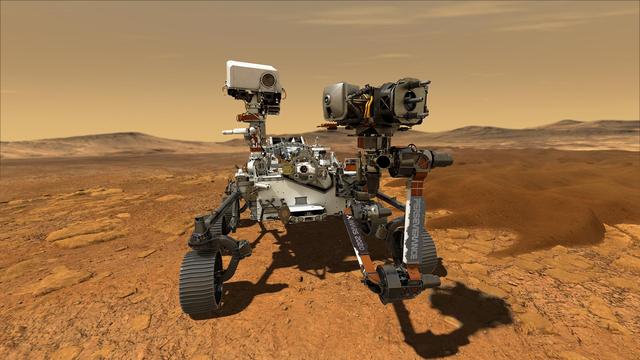
Capability Need/Knowledge Gap: (1) Next-gen rover missions will utilize both cameras & LIDAR to navigate, but traditional sensor fusion approaches collect too much 3D data for real-time processing. (2) Active cooperation between camera & LIDAR can generate optimized 3D maps, with dense useful data i...
Proposed Goals/Objectives: The proposed effort will automate needling processes...
Status: Active
Proposed Goals/Objectives: The proposed effort will automate needling processes for all variants in the Materials Engineered for Re-entry using Innovative Needling Operations (MERINO) family of TPS. (1) Apply the (currently idle) multi-million-dollar Robotic Arm facility in N210 for optimized fiber ...
Proposed Goals/Objectives: Our goal is to better understand the physics governi...
Status: Active
Proposed Goals/Objectives: Our goal is to better understand the physics governing Mag-EC ELISA detection. Our hypothesis is that we will be able to measure individual bead constructs as they impact an electrode surface. Further, we believe that we can leverage this phenomenon by using a large amount...
Capability Need/Knowledge Gap: There's a critical need to detect harmful bubb...
Status: Active
Capability Need/Knowledge Gap: There's a critical need to detect harmful bubbles inside opaque cryogenic transfer lines for NTP missions, as current methods can't, risking turbopump failure and engine restarts. A real-time detection capability is missing. Objectives: Calibrate acoustic sensors on a ...
Proposed Goals/Objectives: There is a need for longitudinal monitoring of body...
Status: Active
Proposed Goals/Objectives: There is a need for longitudinal monitoring of body’s physiological response, such as bone quality, to spaceflight. Traditional bone biomarkers have known limitations, thus the need for investigation of novel biomarkers of skeletal health. MicroRNA (miRNA) are short, non...
Proposed Goals/Objectives: Spaceflight health monitoring lacks compact, high-s...
Status: Active
Proposed Goals/Objectives: Spaceflight health monitoring lacks compact, high-sensitivity tools to detect biomarkers of radiation-induced oxidative stress in real time. We aim to advance our carbon nanotube (CNT) sensor system for detecting radiation-induced volatile organic compounds (VOCs) by optim...
Proposed Goals/Objectives: Enable a high-contrast imaging testbed for NASA’s H...
Status: Active
Proposed Goals/Objectives: Enable a high-contrast imaging testbed for NASA’s Habitable Worlds Observatory (HWO) by re-utilizing and upgrading the SOFIA vacuum chamber. HWO will be the first observatory to directly image Earth-like planets around sun-like stars and search for signs of life with a g...
Capability Need/Knowledge Gap: To enable Mars helicopters that can carry more ...
Status: Active
Capability Need/Knowledge Gap: To enable Mars helicopters that can carry more science payload, rotors that have higher blade area (high solidity) are necessary. There is little research for Earth-based helicopters with high solidity. Objectives: (1) Develop design guidelines and rotor designs for hi...
Capability Need/Knowledge Gap: Improved imaging of dim astrophysics phenomena,...
Status: Active
Capability Need/Knowledge Gap: Improved imaging of dim astrophysics phenomena, particularly for habitable Earth-like exoplanets, and higher precision, particularly for Mars mapping and deep-space navigation. Related to Civil Space Shortfalls 1598 and 1604, as well as 1626 Objectives: Improve imaging...
that directly controls uncertainty and provides a theoretical guarantee of solut...
Status: Active
that directly controls uncertainty and provides a theoretical guarantee of solution optimality. The current 6-DOF PDG algorithms such as Penalized Trust Region lack both capabilities. First, they are modeled deterministically and rely on extensive Monte Carlo simulation to validate robustness under ...
This project aims to advance photon-counting imaging with large superconducting ...
Status: Active
This project aims to advance photon-counting imaging with large superconducting nanowire single-photon detector (SNSPD) arrays, targeting time-resolved single-photon imaging. I will develop a fast imaging array with readout electronics and real-time data processing to count billions of photons per s...
Lunar dust is composed of extremely fine, abrasive, electrostatically-charged pa...
Status: Active
Lunar dust is composed of extremely fine, abrasive, electrostatically-charged particles that damage equipment and threaten human health on long term and crewed exploration missions. Current mitigation strategies address individual challenges, but this requires unique procedures both during terrestri...
With the recent maturation and improvements in computational capabilities, the d...
Status: Active
With the recent maturation and improvements in computational capabilities, the discovery of novel materials can be rapidly accelerated for application-specific material properties, like high-temperature strength, modulus, hardness, fracture toughness, and creep. For this approach to work, computatio...
Nuclear Thermal Propulsion (NTP) is a low-readiness-level technology that enable...
Status: Active
Nuclear Thermal Propulsion (NTP) is a low-readiness-level technology that enables human space exploration with reduced travel times and costs. However, current solid-core NTP systems, which utilize hydrogen as a propellant, suffer from mass loss due to the interaction between hot hydrogen and the fu...
As space exploration progresses, ensuring sustainability in extraterrestrial env...
Status: Active
As space exploration progresses, ensuring sustainability in extraterrestrial environments, particularly for human missions to Mars, becomes essential. In-situ resource utilization (ISRU) strategies harness local resources, such as abundant carbon dioxide (CO2) in the Martian atmosphere and water (H2...